
Pills, pipes, and policy

philomaths.tech
Follow on Instagram, X, LinkedIn. Brand built with achoo studio
Newsfeed: to help you track what’s happening in Baltic tech and global tech that matters to builders here. No algorithms. No AI-curated feed. Just people who build things, following other people who build things, and surfacing what’s worth your attention.
editor@philomaths.tech
work in progress
Health and Medicine. Couple exciting new founders in the space. Erin (previously CEO at HRA Pharma, which was acquired approx $2B) joins metasThera as Executive Chair and Co-Founder alongside “cancer metabolism rockstar Dr hab. Maria Mycielska”. In Lund, Sweden, Eimantas secured first VC investment for Emulsi Biotech; they are developing a proprietary lipid-based drug delivery technology designed to improve the oral delivery of biological drugs.
Deep energy. Deep tech is where venture seems to be least desparate — where your founders don't need to compete again dozens SV overfunded AI-natives (as it often feels in software). And with compute needs, energy remains trendy, attracts founders as Liene (NaionX) or Radiant Robotics guys (in Latvia); also Artiom with SantakaPV.
Plumbing. Big supporters for teams pursuing "European plumbing” — building complex products to unlock pan-European trade and commerce. We wrote how the likes of Vinted, Ovoko, Saltz are "anti-fragmentation” plays. Exciting to see Axiology having traction with ECB which switched on Pontes.
Travel. NordVPN shipped PriceMice — a free browser extension that checks what the same hotel room costs from different countries. Anastasiya is pitching EasyMiles. Saily is more like rockety when you look at hiring rates.
Policy frontier? Last night discussions: why LT tech founders engage with public policy? We are seeing amazing initiatives in education (Rytis), investigative journalism (Thomas), defence (Arnas)… There will be more. Why?
You'd expect a world-class CEO to run a 1,000-person company - constantly learning, attracting great people, benchmarking against the best globally. Lithuania will spend north €1.8bn on education this year. Wouldn't we expect the people leading education system of that scale to operate at the same level? Now look who is in charge now.
The gap is huge, expectations for the country are rising, a lot of tech people are young & care about the future, they are not insecure + don't need to maximize personal gains anymore - they will continue to get involved in meaningful activities. It often starts small, like this write up about the costs of underperforming transport system.
People moves. Augustina is now Senior L&D Partner at Hostinger. Agnius joins Incogni (Surfshark) as Partnerships Manager. Raimonda is now Marketing Manager at Altechna. Justina joined Hostinger as PR Manager.
sponsors

Cloudvisor [launched a free tool that scans your AWS account like a solutions architect and finds mistakes before they become expensive. It's called Refraxion.]
Hostinger [online presence accessible to everyone worldwide, hiring]
Google For Startups [cloud credits up to $350K, faster growth]
Ovoko [join to transform Europe’s €30B+ used car parts market]
Oxylabs [Step into the world of web data gathering]
VIALET [Business accounts for growth, hiring]
Surfshark [Top 50 among fastest growing in EU, hiring]
Eldorado.gg [world’s largest in-game trading marketplace, hiring]
Eneba [join the marketplace 20M gamers love]
InRento [Investments in real estate projects with income, growth, and impact]
rounds and capital
Repsense secures 1M venture debt from SEB, which suddenly emerged timely as credit partner for fast growing firms. We talked in New Guardians issue that Repsense is well positioned to grow.
Daumantas was cooking Slicer.dev which leads to 100k ticket for solo founder by FIRSTPICK and Lost Astronaut.
“Touched by Vinted” (actually acquired by..) United Wardrobe founders now venture investors in Netherlands.
three questions
Repeat founder with impressive track record. Einaras von Gravrock launched CUJO AI and co-founded CAST AI. Now he is building CUBE AI, which is growing rapidly - deploying AI agents against scammers.
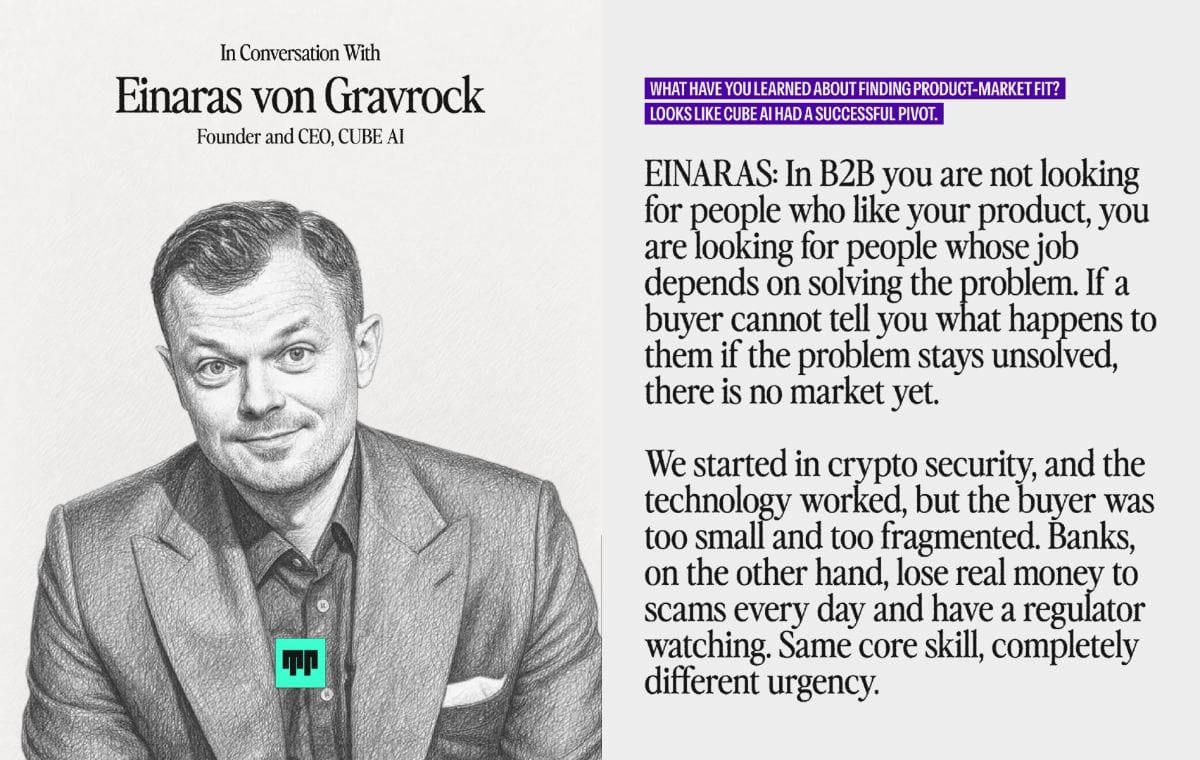
CUJO, CAST AI, and now CUBE AI: the same pattern. What does Lithuania give you that the Bay Area can't?
Density of serious engineers who actually ship. In the Bay Area you compete with a thousand companies for the same people, and half of them are optimizing their next job hop. In Lithuania you can build a team that stays together for years, which is where compounding really happens in deep tech. The talent pool is small but the ratio of builders to talkers is unusually high. Add a time zone that overlaps with both US mornings and Asia, and a culture that doesn't panic when the problem is hard. The US gives us customers and capital. Lithuania gives us the product.
What have you learned about finding product-market fit? Looks like CUBE AI had a successful pivot.
Three things. First, in B2B you are not looking for people who like your product, you are looking for people whose job depends on solving the problem. If a buyer cannot tell you what happens to them if the problem stays unsolved, there is no market yet.
Second, pivot on evidence, not mood. We started in crypto security, and the technology worked, but the buyer was too small and too fragmented. Banks, on the other hand, lose real money to scams every day and have a regulator watching. Same core skill, completely different urgency.
Third, kill your attachment to the old story fast. The hardest part of a pivot is not the engineering, it is the founder admitting the first thesis was wrong in front of the team and investors. Do it once, do it clearly, and move.
Full interview here
roleplay
Oxylabs - Head of Data, Analytics & AI
Hostinger - Head of Product (agentic ecommerce)
Ovoko - Head of Marketing, Engineering Manager
Eldorado - CFO and Brand Lead
Surfshark - Brand Strategist, Head of Partnerships
VIALET - Chief Accountant
Rods - Head of Growth
Military Intelligence and Counterintelligence - Developers, analysts
Bilance - Growth and Community
VDU University - Head of Endowment Fund
brand + design
Expectations. Some industries have long prioritized digital experience; others barely tried. One of the reasons why some sectors held is that consumers had no reason to expect anything better.
But customer expectations travel to other industries.
Digital design helped reshape banking, travel and retail because switching was easy and challengers could win on the screen: Wise, Airbnb, Vinted to name a few made that contrast visible, and the experience itself became part of the reason to switch.
What are some industries that comes to mind that completely ignored any type of priority of their customers experience online? Healthcare, government and legal services stubbornly held out. They just faced less pressure to improve.
The opportunity is obvious for these industries and design thinking is a natural enabler of new, value-adding experiences. The obstacle is that many such organisations still treat design as a production level task.
It takes a champion in leadership who gives design a voice in shaping the service from the start.
Blanding to olding. Augustinas noticed how brands are trading bland minimalistic identities for familiar symbols and nostalgic looks. In uncertain times, familiarity feels comforting. But with more creative tools than ever, why does so much of our visual imagination still look backwards?
Patrick Collison (Stripe) and Tyler Cowen’s New Aesthetics grants explore a related question: what should this century look like?
Experimenting with AI’s potential to make design more distinctive. What visual languages could these tools make possible that we haven’t yet imagined?
Baltic Global Brands Index. A first-of-its-kind study ranking the region’s leading tech brands by their global visibility. The final ranking will be revealed September 25th at the Baltic Brand Forum in Rīga. The shortlist includes Hostinger, Ovoko, Surfshark, Oxylabs, and more.
further insights
On the decline of reading or Doomscroling ourselves to death. A massive and growing segment of the population has stopped opening books altogether. A study found that the share of people reading for pleasure daily plummeted from 28% in 2004 to just 16% in 2023. That is a 40% decline in two decades, or a 3% drop every single year.
”Most salient and worrying trend: that people in positions of power and influence are now notably ignorant about history and the classics, comfortable only with referencing pop culture. I suspect that the crisis of faith in our institutions is driven not just by a sense that they are corrupt or biased, but that the people running them are not very smart.”
Member discussion