
Device-led
philomaths.tech
Follow on Instagram, X, LinkedIn. Brand built with achoo studio
Newsfeed: to help you track what’s happening in Baltic tech and global tech that matters to builders here. No algorithms. No AI-curated feed. Just people who build things, following other people who build things, and surfacing what’s worth your attention.
editor@philomaths.tech
work in progress
Device-led. If software is now too easy, too competitive, no moats — hardware can build that edge. Software moved away from being deterministic, but this still stands in hardware. Software makes building almost too easy, but hardware is what captures the context, the data - or solves real world atom problem.
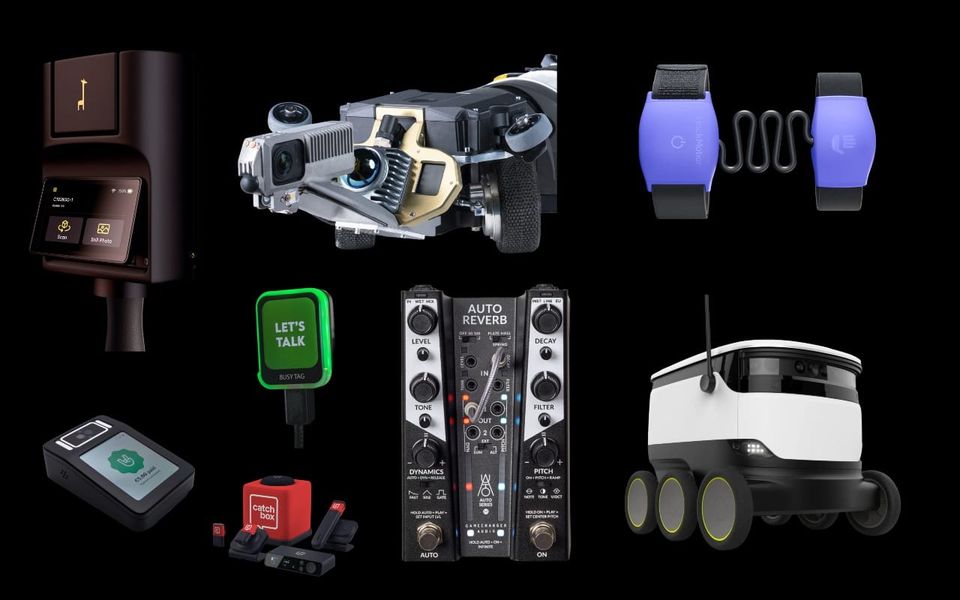
Suddenly a bunch of startups in the Baltics became more interesting. Notice how Latvia stands out with some truly creative takes on gadget-first businesses (only one in picture above is Estonian).
Consumer is the most exciting space — just look at skyrocketing growth by the likes of Pulsetto (just launched Fix X) or Fieldy. We can't forget Axiometa either. What is overlooked is how nicely (and sustainably) other device-led consumers businesses grow. For car / motorcycle enthusiasts, that is OBDeleven (20M rev), Monimoto (beyond 5M), Mbito (fast-growing). In sports and hobbies, it is Hackmotion (10M+) and Deeper (20M+, strong growth last year). Smaller, GameChanger Audio has been building pedals for music instruments. Amazing to report these companies are all growing... profitably.
Businesses need some hardware, too. Latvians came up with famous Giraffe360 (beyond 10M rev, backed by Founders Fund) camera for real estate agents, Catchbox (6M last year, passed 1M monthly revenue this year) with professional wireless microphones, and a newly launched Handwave (3.65M raised, palm payments for retailers). More complex products - robots – is where VC bets tend to go most. Is it drones (many, we are leaving defence / dual use aside this time), or the likes of Aerones (again Latvian monster, we are guessing EUR 30-40M revenue) and Starship robotics (22M rev 2025 Estonian entity), recently backed by Plural.
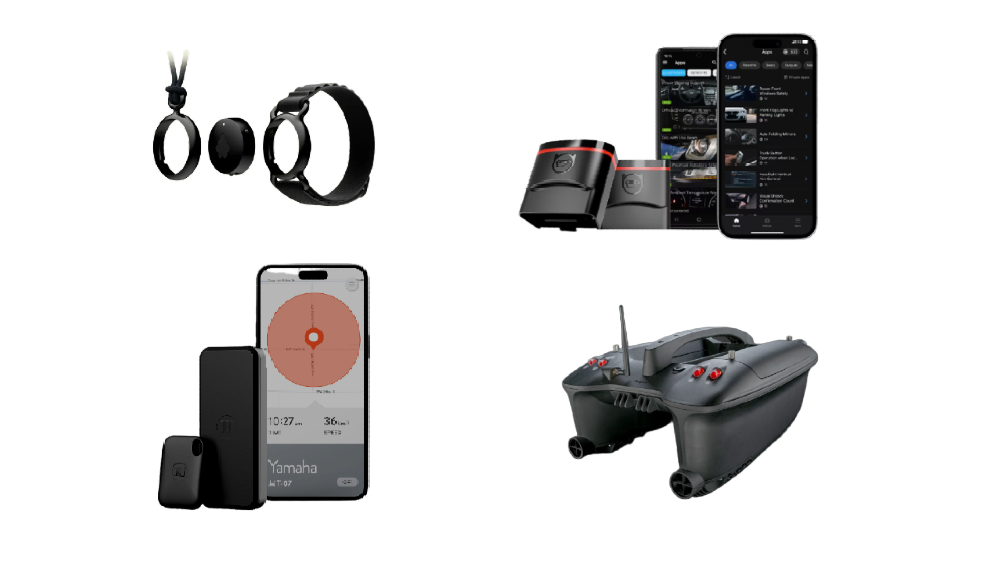
Women researchers > tech founders. We've been noticing the trend of Lithuanian researchers turning science into products, and starting new ventures abroad. Truly impressive batch, novel ideas and deeptech products. We list 14 founders, including:
Kotryna / Elvina Juršėnaitė (Poland / France), Gabrielė (Norway), Nemira (UK), Margarita (Denmark), Erika (UK) and others.
Domain edge. “Earned advantage concept is as old as Y Combinator. Amazing products get built by founders who have experienced the problem first hand. Fresh example this week - EnforceShield raised 1.7M seed - with Rytis having attorney experience, incl time spent with Orbio and tech customers. Immediate other stories include Onodrim, Ovoko, Axiology, Eany, Repsense, GREI, Saltz, Evergrowth, where founders have first-hand experience in the industry they are serving.
Circularity. Stellantis aftermarket division — SUSTAINera — joins Ovoko marketplace, with already 7000 sellers across Europe. Refurbished LEGO sets by Sort A Brick are coming very soon. Tesonet joins EUR 20M Index-led Nomos investment round - which is a full-stack power company (plugs home batteries, EVs, heat pumps and solar to the energy market). Renewable Energy Certificates may sound niche, but does not stop Estonian Soldera from growing rapidly.
Expensive tokens (but crypto days). Law enforcement strikes against Bankera founders: allegations of EUR 45M assets wasted. Happening after 15min deep investigation.
Aggregate pipes. Startup founders know, if there multiple channels firms use - they will try bundle into one interface / platform or API. Shipping and multiple carriers is one problem to solve: Swotzy has been named the #3 fastest growing startup in DACH & CEE in the Sifted 100 for 2026, and OrderKrab (ex-Vinted founder) will try to follow the trajectory.
People moves. Bernardas steps into CEO role of InRento, taking the lead from the founder Gustas — already funded 126M in projects at 0% default rate. After 13 years and incredible journey - one of early marketplace scale-ups that became global leader in the field, raising capital and navigating growth, followed by a successful turnaround — Dalia is leaving CGtrader. Ahmad is new Head of Baltics at EBRD. Aivaras is now Head of Product at Incogni. Zane joined Mintos. Ernestas leaving Podimo for smth new. Nijole is now CMO at Horizontal Media.
sponsors
Cloudvisor [launched a free tool that scans your AWS account like a solutions architect and finds mistakes before they become expensive. It's called Refraxion.]
Hostinger [online presence accessible to everyone worldwide, hiring]
Google For Startups [cloud credits up to $350K, faster growth]
Ovoko [join to transform Europe’s €30B+ used car parts market]
Oxylabs [Step into the world of web data gathering]
VIALET [Business accounts for growth, hiring]
Surfshark [Top 50 among fastest growing in EU, hiring]
Eldorado.gg [world’s largest in-game trading marketplace, hiring]
Eneba [join the marketplace 20M gamers love]
InRento [Investments in real estate projects with income, growth, and impact]
rounds and capital
EnforceShield announced a €1.7M seed round led by Vendep Capital, with FIRSTPICK joining the round.
Creem. Estonian billing and monetisation platform has raised a €5 million seed round led by Polish fund Inovo VC to fast-track its growth.
Furniture1 completes another acquisition - this time FurnOn in the UK. Pijus and the team not stopping, looking also at Balkans, Marocco, Georgia too.
Costpocket has been acquired by Mynt in Estonia; terms not disclosed.
three questions
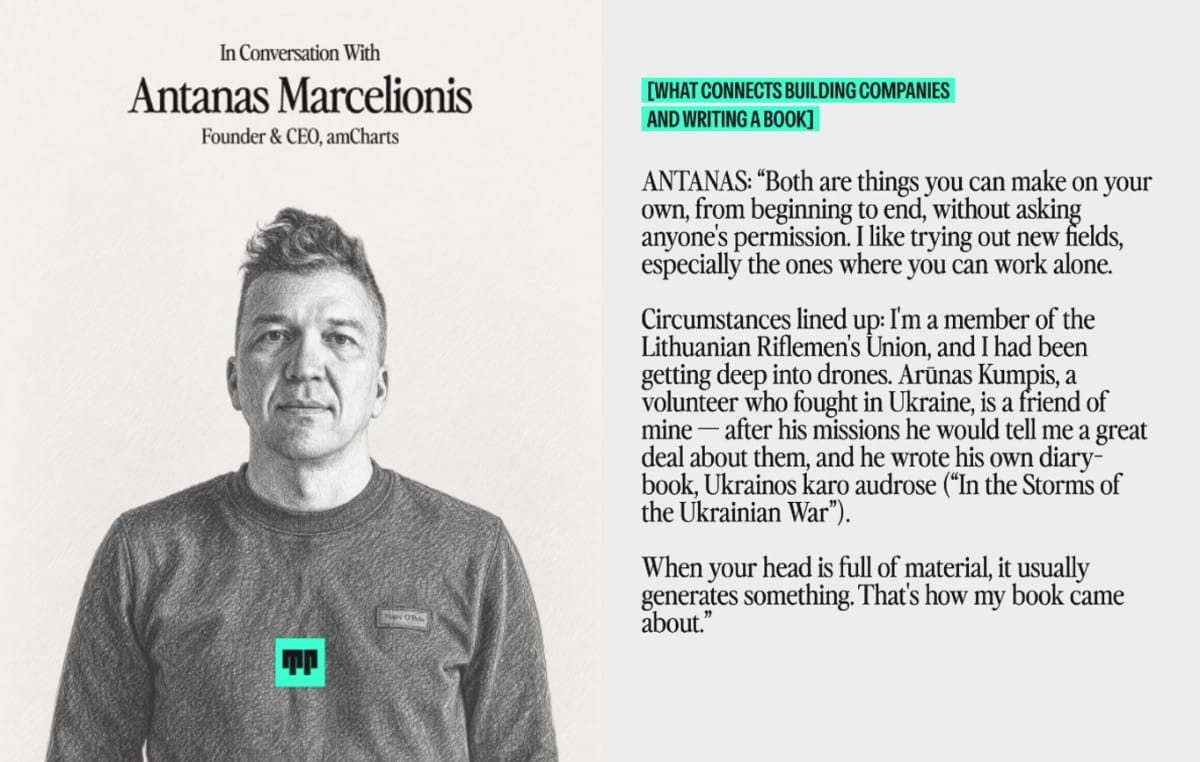
Thrilled to talk to Antanas Marcelionis, the famous yet very under the radar founder of amCharts. Scaled amCharts to thousands of companies, with tiny team (= impressive business). Now author of popular sci-fi techno thriller.
You built amMap in 2004 as a pin-map for yourself and quit your job in 2006 with no clear idea of what came next. What happened after that?
I flew to Spain, got on a bicycle and started pedalling. I came across the Camino de Santiago by accident — everyone knows it now, but back then I had never heard of it. I rode for about a month, through Spain and Portugal. My head cleared, and I understood that I wasn't going back to the office (I had my own web design company). I freelanced for a while, and wrote a script that drew a pie chart. After that, things went roughly like this:
Within a couple of years amCharts (that's what I named the product, after my initials) had become one of the best-known data visualization libraries in the world. If you opened up the Fortune 500, probably every second company on the list has bought an amCharts license of some kind. In 2009 Apple tripped us up a little: they announced that their phones and computers wouldn't support Adobe Flash, and the library had been built in Flash — at the time that was the standard rich media format. By the time I had a JavaScript version ready, competitors who had been writing in JavaScript from the start had taken a large share of the market. I had to play catch-up.
Twenty years have passed and amCharts is still going — we keep releasing new versions and new products.
You kept the team deliberately small and the amCharts business grew anyway. What is the scale of amCharts today? Did this growth surprise you?
Right now there are two of us: me and Martynas Majeris. At one point we had expanded a little, but we couldn't keep support under control. I don't remember exactly, but I don't think we ever had more than six people at one time.
We have never done any serious marketing. Our position is that a good product markets itself. To be honest, that strategy no longer works. Today a good product does not market itself — you have to push it. We were simply lucky — old enough to have caught the moment when making a good thing was still enough.
Besides, marketing would need people, more customers would mean a bigger team, and neither Martynas nor I want that at all. And now that a large part of the work can be delegated to AI, I see even less point in having a big company.
What connects amCharts and Master Version 1.1, if anything beyond the author? Why did the book come out when it did, and will there be more?
The author — and the English translator — is the entire amCharts team. Seriously though, it isn't only the author that connects them: both the library and the book are things you can make on your own, from beginning to end, without asking anyone's permission. I like trying out new fields, especially the ones where you can work alone.
Circumstances lined up: I'm a member of the Lithuanian Riflemen's Union, and I had been getting deep into drones. Arūnas Kumpis, a volunteer who fought in Ukraine, is a friend of mine — after his missions he would tell me a great deal about them, and he wrote his own diary-book, Ukrainos karo audrose ("In the Storms of the Ukrainian War"). When your head is full of material, it usually generates something. That's how my book came about.
Will there be more? I won't promise anything; I haven't started a new one. I've heard it said that the second one is harder to write, especially if the first one went well.
AI has shifted the moat under every developer library, yours included. How do you see the future of products and teams like amCharts?
AI both hurts us and helps us — we build and improve the product itself faster than ever. But our main customers are other developers, and instead of reaching for a library, they simply ask an AI to draw the chart. They get a result that looks perfectly good at first glance. But that drawing is usually a one-off: untested, unverified. For some people that is enough, of course. So I won't hide it — it does affect sales. But there are only two of us, so no tragedy happened: we don't have a team or an office to keep alive.
Predicting what comes next is hard. Right now developers are churning out projects like mad, delighted that in a single day they can build what used to take months or years. But it raises a question: is there actually demand? Who needs that many products? And if one of them does turn out to be a success, what is to stop the AI company from improving the tool itself so that it provides the same service on its own? We may well end up with one or a few mega-corporations providing every service there is — especially when, or if, we reach AGI.
Where that leaves companies like ours, I don't know. I only know that we'll adapt. And if not, there's a plan B — I already live in the countryside, growing vegetables and keeping five chickens (free eggs!).
Visit amCharts: amcharts.com
Read the book: masterversija.lt
roleplay
Hostinger - Head of Product (agentic ecommerce)
Ovoko - Head of Marketing, Engineering Manager
Eneba - Heads: Finance, Accounting, Influencer+Affiliate
Eldorado - CFO
Surfshark - Brand Strategist, Head of Affiliates
VIALET - Content Project Manager
Military Intelligence and Counterintelligence - Developers, analysts
Solid IO - Co-founder (Life Sciences)
Monopulse - Product Owner + UAV Engineer
Ace Waves - Events & Workplace Manager
Kaching Appz - Full-stack devs
brand + design
Can you dig it. NordVPN just drafted Shaq for their global campaign. It’s sort of a milestone when a Lithuanian tech company has both the budget and the cultural capital to tap into one of the most recognizable athletes on the planet to promote their product. And he is coming to Lithuania to see Zalgiris first Euroleague season match. Fingers crossed there are no Shaqtin' a Fool moments.
founder's guide
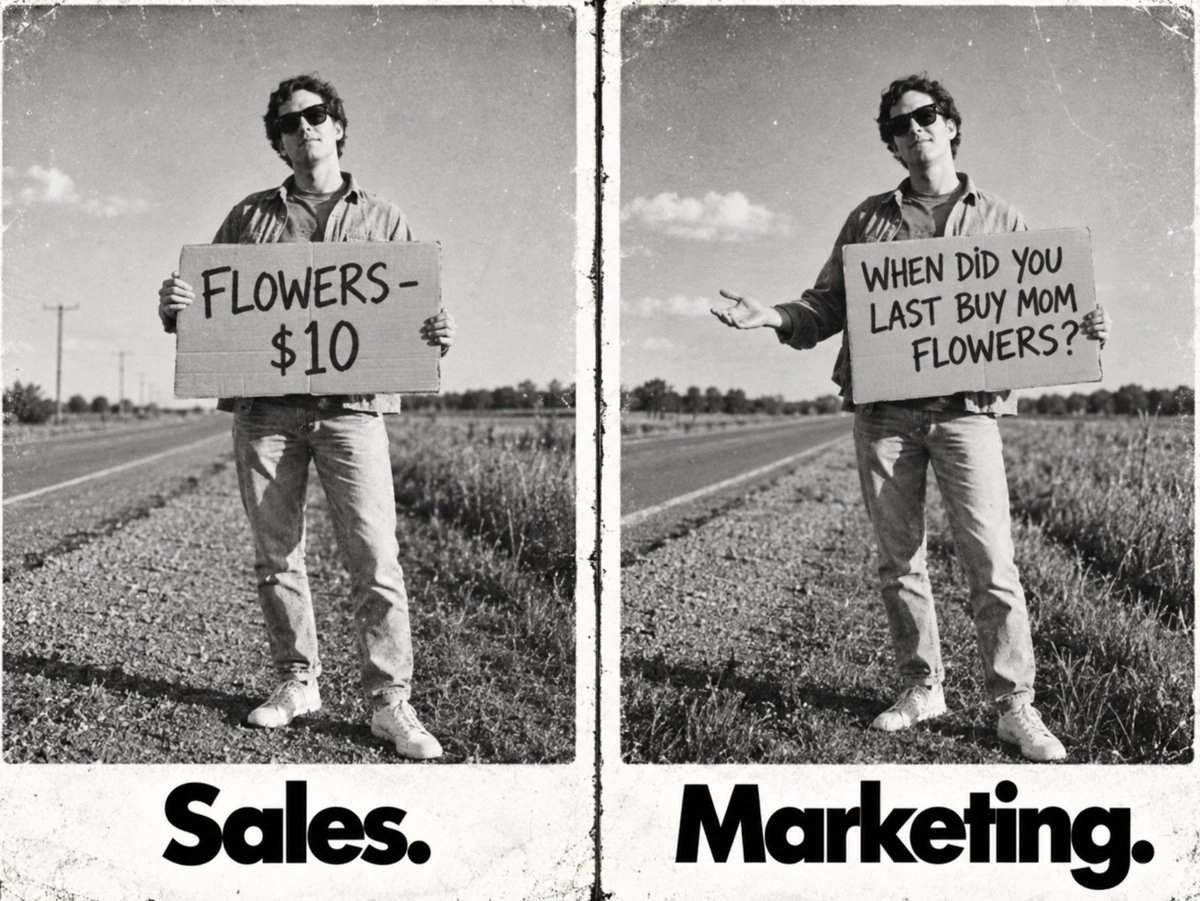
A good product needs a push. Here’s a good example between selling a good product and marketing it in 1 photo.
This is genuinely good. Do less of what others do. 60+ new creative growth ideas
Interesting profile / interview with Kaidi Ruusalepp. From Nasdaq CEO in Tallinn, to founding Funderbeam, to Nordic nature hospitality brand. We generally recommend reading Fomo Observer to track Estonia well.
further insights
Not too surprising is it? Most people prefer traditional architecture.
A small thing that quietly costs startups a lot: the AWS reseller they pick determines which AI models they can actually use. Cloudvisor is now an authorised Anthropic reseller.

ecosystem
Couple takes on what might happen to Air Baltic - Karolis and Simonas
Member discussion