
Deus ex machina

philomaths.tech
Follow on Instagram, X, LinkedIn. Brand built with achoo studio
Newsfeed: to help you track what’s happening in Baltic tech and global tech that matters to builders here. No algorithms. No AI-curated feed. Just people who build things, following other people who build things, and surfacing what’s worth your attention.
editor@philomaths.tech
work in progress
Four wheel economy. Ovoko is combining very strong momentum (+20 openings for top talents) and having fun - they just had full race experience at 1006km event. CarVertical brakes EUR 75M revenue in 2025. Sigvi just raised 1.2M pre-seed - Darius breaks down their vision+traction in this video. Lectrium founders Peter and Ziggy reflecting on the journey so far. Elinta Motors stable profitable at 11M-12M annual revenue. Bolt Drive is live in Warsaw - can this model scale across Europe well?

New founders, building in the US. Justinas Banys working on smth new in New York (stealth mode) - added the list of LT founders in the US. Justinas Zaliaduonis and the team launches Fermisense — the knowledge discovery company.
B2B SaaS much alive? Latest fundraising news brings a set of software companies that resembles the usual SaaS template; they address B2B with workflows, automation, and AI features. Sigvi just landed €1.2M in pre-seed funding to help car rental step up (anyone renting a car in southern Europe this summer know how broken the industry is). Ordero has raised €150K for meal ordering platform - they already scaled locally with kindergartens and schools. Previously, Backoffice raised €150K to bring restaurant and hospitality operations under one roof. Thoughts on these –
- Look like seedstrapping deals - raising once or twice, getting to profitability asap
- Much less capital needed than before - and most for GTM
- Solving real problems, meeting customers where they are + revenue traction and retention never gets old
- vertical SaaS has some beauty given they becom critical workflows, have high switching costs, allows combination of subs + payment fees
Consumer, apps. Surfshark is evolving - into a platform - with latest HeyPolo release. Lenders launched Verito, app to check your credit score. WhiteBridge has officially launched its iOS app. Popcorn, co-founded by Lukas Kairys, seem to be taking off.

Ecomm rails? We've been spotting number of software players that solve the issues ecommerce / DTC companies run into. Another one to watch - Enforceshield. Kopa ai recalibrating to focus on local businesses. Vinted rails… are different - Vinted Go to unlock Germany at scale - signed partnership with DHL, which has 41,000 collection points.
Fintech. Hokodo stopped trading, and Lithuanian entity gets acquired by Aspora, a US company. Gustas sharing InRento founder story at a podcast.
Systems and simulations. Keep an eye on Trace.Space - they want to enable hardware teams to move faster: demand if there is product solves the issue. Blackswan Space keep expanding, hiring simulations and unity graphics engineers.
Cloud and AI. Refraxion (just launched) — new spinoff from Cloudvisor — gives startups one view of their entire AWS posture: security, cost, and reliability in a few clicks. PushOps closed '25 at 1.3M revenue, burned cash but grew well. Collony has joined the Google Cloud for startups cloud program.
People. Sjuul leaves Vinted (joined when United Wardrobe was acquired). Rasmus leaving Sunly and sharing his learnings. Mindaugas Savickas leaves SEB to join Hostinger. Martynas, ex-Spike, joins Hostinger, too. Mindaugas joins Reap as Head of Marketing, and looking to hire B2B paid ads talent. Madis, software engineer, left Fyma - open for smth new.
Revenue scaling. Which scale-up will hit 50M revenue mark first? Is it IPXO, PVcase, OBDeleven, Eldorado.gg or RSI Europe? Wanted to add Eneba - but they are long gone pass this goal post.
sponsors
Cloudvisor [now offering stress-free migration from any cloud to AWS]
Hostinger [online presence accessible to everyone worldwide, hiring]
Google For Startups [cloud credits up to $350K, faster growth]
Ovoko [join to transform Europe’s €30B+ used car parts market]
Oxylabs [Step into the world of web data gathering]
VIALET [Business accounts for growth, hiring]
Surfshark [Top 50 among fastest growing in EU, hiring]
Eldorado.gg [world’s largest in-game trading marketplace, hiring]
Eneba [join the marketplace 20M gamers love]
InRento [Investments in real estate projects with income, growth, and impact]
rounds and capital
Sigvi, revenue agent for the car rental industry, raised €1.2M pre-seed, led by Superhero Capital, joined by Vladas Lašas, alongside other angel investors.
Ordero has raised €150K from FIRSTPICK together with Lost Astronaut - for meal ordering platform.
three questions
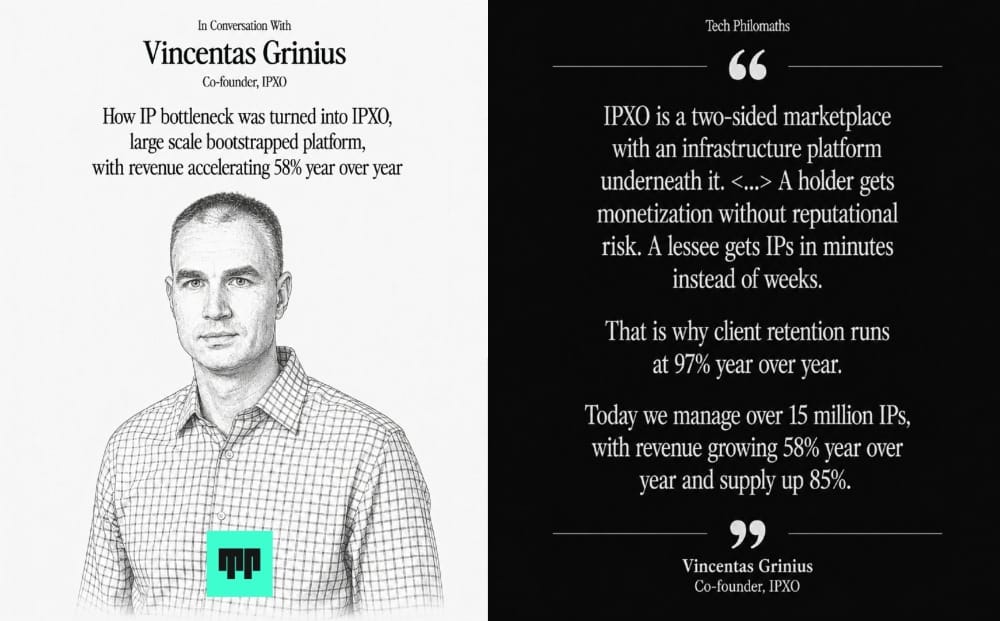
Excited to talk to Vincentas Grinius, co-founder of IPXO. Most people would be surprised how big this business actually is - it's grown far past what its public profile suggests, and still accelerating at 58% a year. All of it bootstrapped.
You spent more than a decade in web hosting before IPXO. What was the moment, and the reasoning, that made you turn to IP addresses?
I ran hosting businesses for over a decade, starting in 2008 with Host1Plus, which later became Heficed. The recurring bottleneck was always IPv4. Free pools were gone by the mid-2010s, and acquiring space meant brokers, escrow, and weeks of waiting at prices nobody could verify. At the same time, I kept meeting organizations sitting on huge unused allocations with no safe way to put them to work. Leasing existed, but as handshake deals with real reputational risk: if your lessee sends spam, it is your address space on the blocklists.
The moment was internal. At Heficed, we built tooling to manage and monetize our own IP resources; partners started asking to use it, and at some point the IP management system was more interesting than the hosting business sitting on top of it.
The reasoning was simple. IPv4 is a finite resource with structural scarcity, growing demand, and an allocation system designed in the 1980s. IPv6 adoption is real, but the commercial internet runs on IPv4 and will continue to do so for a long time. That is a market that needed infrastructure, not brokers. We spun IPXO out in 2021 to build it.
IPXO seems to be much larger in revenue than people realize. Walk us through the business model — and what's the size of the opportunity you see ahead?
IPXO is a two-sided marketplace with an infrastructure platform underneath it. Holders lease out address space they do not fully use, lessees pay a monthly per-IP rate, and IPXO earns a margin on every lease. The margin is earned under the hood: we are integrated with all five Regional Internet Registries and automate routing, RPKI, WHOIS and geolocation updates, abuse handling, and KYC on every lessee. A holder gets monetization without reputational risk. A lessee gets IPs in minutes instead of weeks. That is why client retention runs at 97% year over year. Today we manage over 15 million IPs, with revenue growing 58% year over year and supply up 85%. <...>
Full interview - our website.
roleplay
Ovoko - Director of Design, Head of Marketing
Hostinger - Head of Product Marketing, Head of Product
Surfshark - Front-End Developer (Web Team)
VIALET - Engineering Manager + more
Eldorado - Category Manager (gaming marketplace)
Cloudvisor - AWS Solutions Architect (Principal Engineer)
Oxylabs - Product Manager + many more positions
Holo AI - 3D/Motion designer (freelance)
Turing College - Growth Marketing Manager + more
Guideless - Copywriter
HireMe - CTO / Lead Developer (Estonia)
brand + design
The Alliance Between Art and Industry. How does a country build a narrative at a global scale? Countries become believable when industry and culture reinforce one another.
Few specific examples come to mind. South Korea, Germany.
Hallyu, meaning the international “Korean Wave” of pop culture, media, and entertainment, exemplifies how cultural exports can shape global perceptions and influence international relations and is now studied as an instrument of national power. That cultural gravity has inspired millions to study Korean, and global talent and capital naturally orient toward Seoul.
Culture might be the only channel through which a country can make claims about itself that people actually believe. Why? Because the audience thinks it reached the verdict on their own. Nobody watches a Ministry of Economy campaign and decides Korea is an innovative powerhouse. They watch Squid Game, use a Galaxy, listen to K-Pop - and conclude it.
Meanwhile, Lithuanian cultural policy is still too easily imagined as preserving national heritage for ourselves, or presenting folklore abroad. Not as a forward-looking economic and geopolitical force that can actively shape what the country becomes and how it is perceived globally.
Germany made a similar move a century earlier. By 1907, it was an industrial giant, but many German products still carried a reputation abroad for being cheap or imitative. Artists, architects, craftspeople and industrialists responded by creating The Werkbund, built around a radical proposition: art serves export competitiveness. The alliance between art and industry made a way and transformed their reputation. "Made in Germany" has collected the premium ever since.
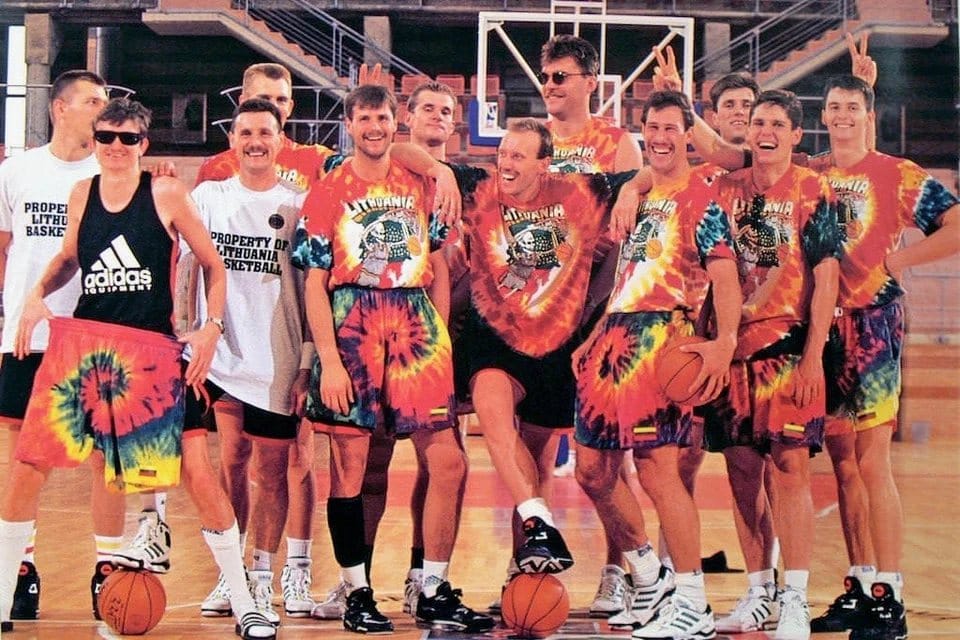
Lithuania has seen this playbook work. In 1992, our Olympic basketball team brought a compelling story. Dressed in Grateful Dead tie-dye shirts they projected reclaimed freedom, underdog grit, and rock-and-roll rebellion. Millions who knew nothing of Baltic geopolitics bought into the cultural gravity.
The fix for Lithuania isn't a new national logo or marketing campaign. It’s an agreement that our Tech unicorns and our Golden Lions are expressions of the same national creative capacity. A glimpse of this is already visible.
When a Lithuanian cultural season in France draws over a million visitors, our tech ecosystem should be in the room. And when our unicorns pitch globally, our cultural edge should be part of the deck as the proof of the talent and creative density behind them.
So maybe the play isn't tech or culture - it's the alliance. Artists wants to create. Tech wants distinct identity and a compelling story. Give them each other: through that we export our culture, through the culture we tell our story, through the story we attract the talent and capital.
A small thing that quietly costs startups a lot: the AWS reseller they pick determines which AI models they can actually use. Cloudvisor is now an authorised Anthropic reseller.

founder's guide
Some largest companies have been started like this - try different things until landing what works, don't be affraid to start, even if looks nonsense - How Mercor built a $20B marketplace with $71 and a Google Form
How to Actually Build Champions in Enterprise Sales
Member discussion